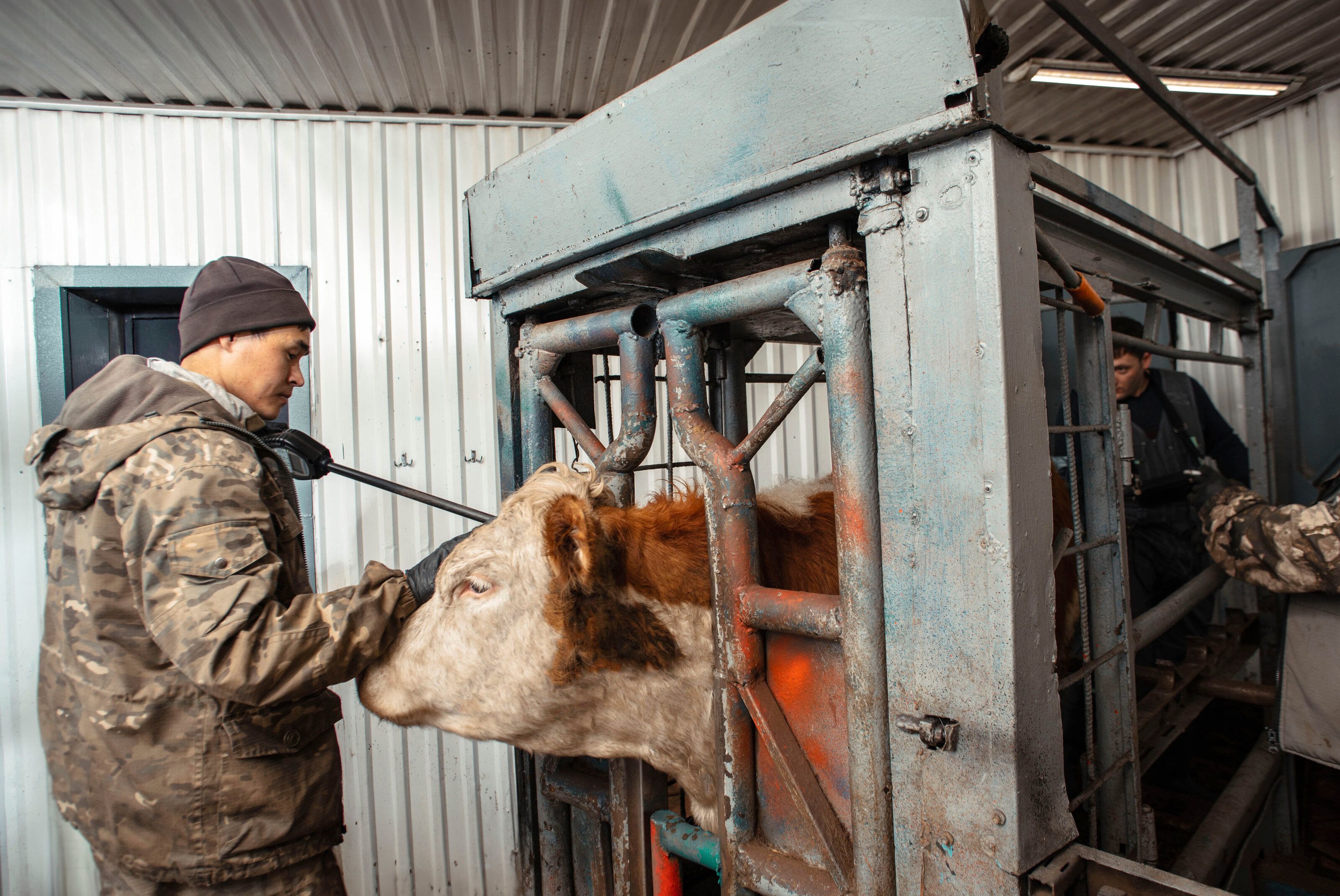
Not every farm has a scale, and taking cattle to be weighed costs time and stress. With a measuring tape and two measurements you can get an approximate weight in the pen, good enough to track growth, work out a wormer dose or know when a steer is getting close to sale weight.
The two measurements
- Heart girth. Run the tape around the chest, just behind the front legs. The tape sits flat against the hide, not pulled tight and not left loose.
- Body length. Measure from the point of the shoulder to the pin bone (the hip bone that sticks out at the back, either side of the tail).
Measure with the animal standing square, all four feet firmly on the ground and the head up, not lowered or turned. If you can, take each measurement twice and use the average.
The formula
This is Schaeffer’s formula, the one extension services teach. It works in inches and pounds:
- Cattle: weight (lb) = girth (inches) × girth (inches) × length (inches) ÷ 300
- Pigs: the same, but divided by 400
To convert centimetres to inches divide by 2.54, and to convert pounds to kilos multiply by 0.4536. For example, an animal with a 180 cm girth and 150 cm length weighs about 448 kg.
Cattle examples
| Heart girth | Body length | Approximate weight |
|---|---|---|
| 150 cm | 125 cm | 259 kg |
| 165 cm | 138 cm | 347 kg |
| 180 cm | 150 cm | 448 kg |
| 195 cm | 163 cm | 572 kg |
Notice that girth counts for more than length in the sum: a few centimetres of badly placed tape change the result by several kilos. That is why it matters to always measure at the same spot.
If you would rather not do the sum, the weight tape calculator does it for you, for cattle and for pigs.
How accurate it is
Expect an error of 5 to 10 % compared with a scale. It drifts further in very fat or very thin animals, in cows late in pregnancy and in animals with a full belly. To compare weighings from one month to the next, what counts most is measuring the same way each time: the same person, the same hour and before they eat.
Keep a history
In the Ganaderos app you record each weighing on the animal’s record, whether from a scale or a tape. The app draws the weight curve and calculates the daily gain between one weighing and the next.