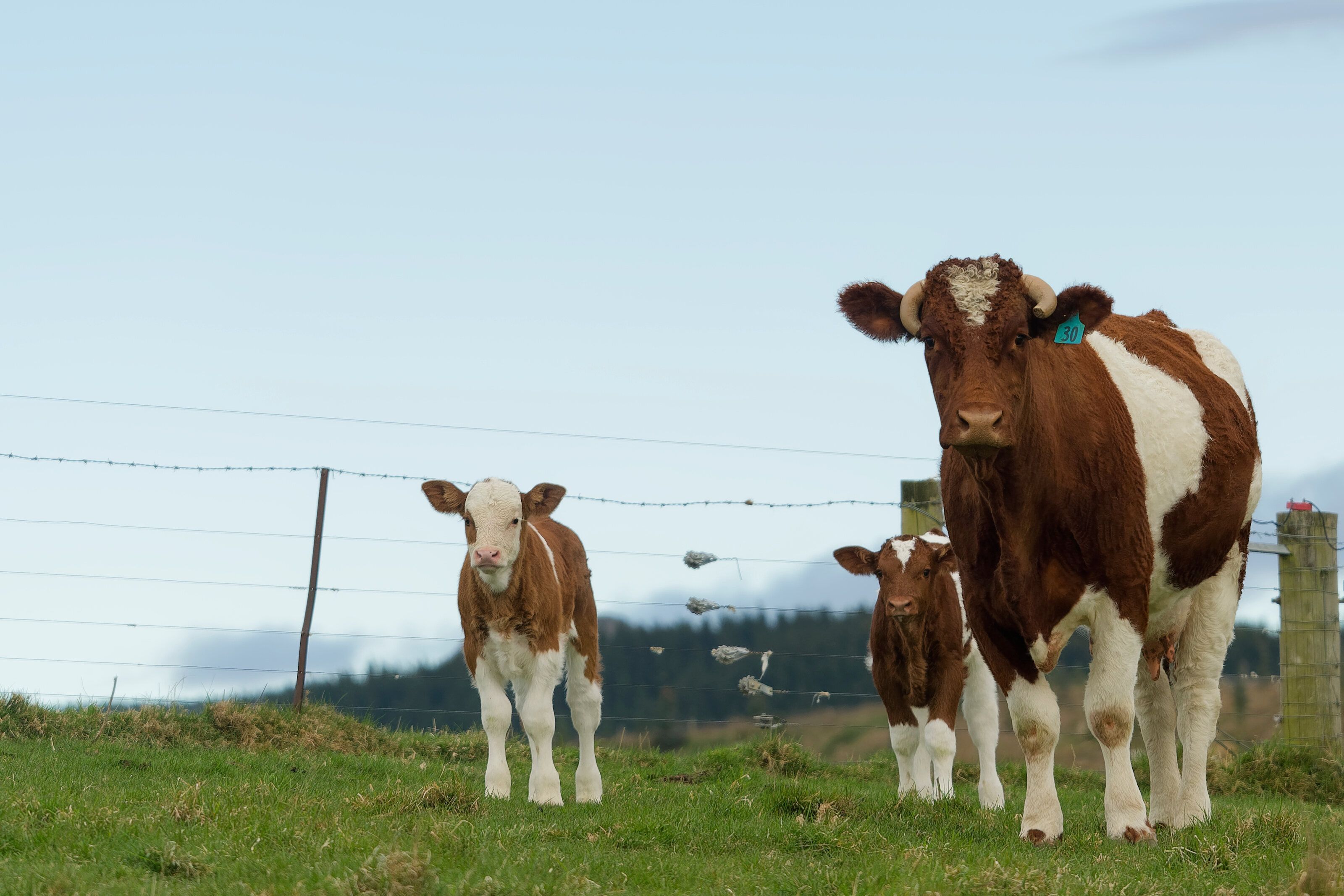
Stocking rate is how many animals a paddock can keep all year without running out of grass. There is no fixed number per hectare: it depends on how much grass your land produces and how much your animals eat.
The animal unit
To compare, we use the animal unit (AU): a 450 kg cow. A cow like that eats about 11 kg of dry matter a day (2.5 % of her weight), which is about 4,106 kg of dry matter a year.
The formula
- Grass you can use = hectares × grass yield (kg of dry matter per hectare per year) × 50 %.
- What one cow eats in a year = weight × 2.5 % × 365 days.
- Cows that fit = grass you can use ÷ what one cow eats in a year.
The 50 % is the take half, leave half rule, so the grass can grow back.
An example with 10 hectares
Native grass with good rain, producing about 6,000 kg of dry matter per hectare per year:
- Grass you can use: 10 × 6,000 × 50 % = 30,000 kg.
- What a 450 kg cow eats: 450 × 2.5 % × 365 = about 4,106 kg.
- Cows that fit: 30,000 ÷ 4,106 = about 7.3 cows, or 0.73 cows per hectare.
The same sum with other pastures (approximate values, your paddock may produce more or less):
| Pasture type | Approx. yield (kg DM/ha/year) | 450 kg cows on 10 ha | Cows per hectare |
|---|---|---|---|
| Native, low rainfall | 3,000 | 3.7 | 0.37 |
| Native, good rainfall | 6,000 | 7.3 | 0.73 |
| Improved temperate | 10,000 | 12.2 | 1.22 |
| Improved tropical (brachiaria) | 15,000 | 18.3 | 1.83 |
The stocking rate calculator does this sum with your hectares, your pasture and your animals’ weight.
Why the dry season matters
The yield in the table is for the whole year, but grass does not grow evenly. In the rainy season there is plenty to spare and in the dry season it barely grows. A paddock that carries 7 cows on average can fall short in the dry months. Do the sum with the dry season in mind, or have hay, silage or another paddock ready for those months.
Overgrazing costs money
Putting in more cows than fit looks like profit, but grass grazed to the ground does not regrow, weeds move in and the soil is left bare. The cows lose weight, you have to buy feed and the paddock produces less the following year. It is cheaper to keep fewer, well-fed animals.
Watch the group’s weight
In the Ganaderos app you organise your animals into groups and record their weights. If a group stops gaining weight, it may be the sign that the paddock is no longer enough. With the Pro plan you get weight analytics for the whole group.